Showing posts with label Netherlands. Show all posts

Tuesday, January 10, 2017

Diet Tips:Europe on a low FODMAP diet: go to the market!

By Peta Hill (Paediatric dietitian)

Whether you’re travelling or living in Europe and on a low FODMAP diet, dining out can be tricky and stressful. A few words of advice: go to the market!

Perform a Google search to find your local indoor/covered, outdoor, farmers and bio/organic markets. 

There, you will find low FODMAP produce available - fruits, salads/vegetables, hard yellow cheeses, cold meats and seafood, olives, nuts, seeds, homemade strawberry jams and more! Plus, you can soak up the atmosphere – the locals, the language, and the cultural specialities. 


Pick up some snacks or a picnic spread to enjoy in a local park or indoors, on the floor of your apartment/accommodation.


If it’s too cold to shop/eat outdoors, head to your local indoor/covered market. With multiple stalls and a variety of cuisines, indoor markets are the perfect choice for couples and families or groups that don’t all have the same dietary requirements or food preferences. You can each choose your dish from a different stand and then sit and enjoy your meals together in the communal seating area.


I am currently living in Amsterdam. I like to shop at Albert Cuyp Market and on Saturday’s at the Farmers Market on Noordermarkt. For eating out, Foodhallen is fantastic. There are over 20 exhibitors/restaurants to choose from and the atmosphere is great: good music and buzzing with locals and expats. But be warned, Friday and Saturday nights are popular and you’ll have to line up for food and wait for a table. My low FODMAP dish of choice? Steamy dreamy shrimp rice paper rolls made to order, right in front of you from Viet View.


Handy hint:

If you know you are particularly sensitive to a high FODMAP food (for example, onion, garlic or lactose) or that a specific food you tolerate well (for example, sourdough bread), Google translate the foods into the native tongue and write them down on piece of paper to take with you to the market.  


Sunday, January 8, 2017

Diet Tips:Dutch low FODMAP breakfast for kids

By Peta Hill (Paediatric Dietitian)


Dutch breakfast (image by Hannah Whitaker via New York Times)
For the typical Dutch child, breakfast is a glass of milk with bread, unsalted butter and most importantly, hagelslag “hailstorm” – sweet sprinkles that come in multiple flavours (chocolate, fruit, anise), shapes and sizes. My local supermarket has half an aisle devoted to them.


For minimising the FODMAPs of the typical Dutch child’s breakfast:

1.       Limit or avoid the fruit sprinkles (vruchten hagel) that generally contain apple juice concentrate (appelsap).

2.       Limit regular bread to one slice and spelt sourdough to two slices. Spelt is everywhere in The Netherlands. However, spelt bread (speltbrood) is not necessarily spelt sourdough (speltzuurdesem). Look for speltzuurdesem in the ingredients panel – it is generally listed second after spelt flour (speltbloem). 

3.       If lactose is an issue for you or your child, choose lactose free (lactose vrij) milk. If opting for soymilk, be aware that those readily available in The Netherlands tend to be based on soybeans (so­ja­bo­nen) and therefore higher in FODMAPs.

4.       If you or your child are particularly sensitive to lactose, limit or avoid white and milk chocolate sprinkles (melkchocoladevlokken). These generally containing milk powder (melkpoeder) and lactose.


For optimising the nutrition of the typical Dutch child’s breakfast:

1.       Swap the butter for peanut butter – another popular food in The Netherlands. The Dutch word for peanut butter is pindakaas, which translates to “peanut cheese”. Aim for 100% pindakaas rather than the alternative that has added oil, sugar and salt. Peanuts are good source of protein, fibre and iron.

2.       Choose wholegrain bread. Wholegrains are richer in protein, fibre, vitamins and minerals.

Also, choose a bread with minimal ingredients, like a sourdough. Sourdough breads are made up of flour, sourdough culture, water and salt. These tend to not contain unnecessary sugar, additives and preservatives and, it’s nice to understand all the ingredients in a product!

3.       Choose dark chocolate sprinkles (chocoladevlokken puur). These are far lower in sugar than the alternatives.

Plus, aim to lightly sprinkle (as opposed to heavy coat!) your bread with hagelslag.

4.       Serve with a portion of low FODMAP fruit. Aside from the fact that fruit is rich in fibre, vitamins and minerals, it’s good to expose children to “something that grows on a tree” (i.e. fruit or vegetables) at each meal.


Fun fact – Make time to sit down and eat breakfast together as a family. According to a UNICEF report, which ranked Dutch children as the happiest in the world, in no other country do children eat breakfast as regularly as they do in The Netherlands. Eating breakfast is associated with: a healthy weight, better performance in school, and decreased behavioural problems. 


Saturday, January 7, 2017

Diet Tips:Dutch Specialities on a low FODMAP Diet

By Peta Hill (Paediatric Dietitian)


One of the best ways to experience a new country and culture is to taste the food. However, estimating the FODMAP content of a foreign cuisine’s dishes is very tricky when you don’t know the ingredients. Here are some insights into five Dutch delights. Unfortunately these products have not been tested for their levels of FODMAPs, so the best we can do is make a judgement of their FODMAP content based on ingredients.

The best place to sample these specialities is at a local outdoor food market. There, you will also find fresh produce, low in FODMAPs available to fill up on whilst you sample local delicacies of unknown FODMAP content. Read up on market shopping whilst in Europe here.

Poffertjes

Poffertjes are small fluffy pancakes usually made from buckwheat flour, milk, eggs, yeast and a pinch of salt. They are served hot, straight from the pan on to paper plates with butter and icing sugar. From a FODMAP perspective, they should be okay but be aware that some poffertjes may be made using all-purpose wheat flour and therefore may be higher in FODMAPs.

Stroopwafels

Stroopwafels are biscuits made from two thin waffles sandwiched together with a caramel-like syrup filling. The waffles are generally made from all-purpose (wheat) flour, sugar, butter, eggs, yeast, cinnamon and salt and the filling from brown sugar, butter, pancake syrup (maple syrup and brown sugar), cinnamon and vanilla. Wheat flour contains FODMAPs, specifically fructans – a type of oligosaccharide. Out of the foods that have been tested for FODMAP content, stroopwafels are most similar to plain sweet biscuits, so it is possible that they may be low enough in FODMAPs to allow a treat every now and again.

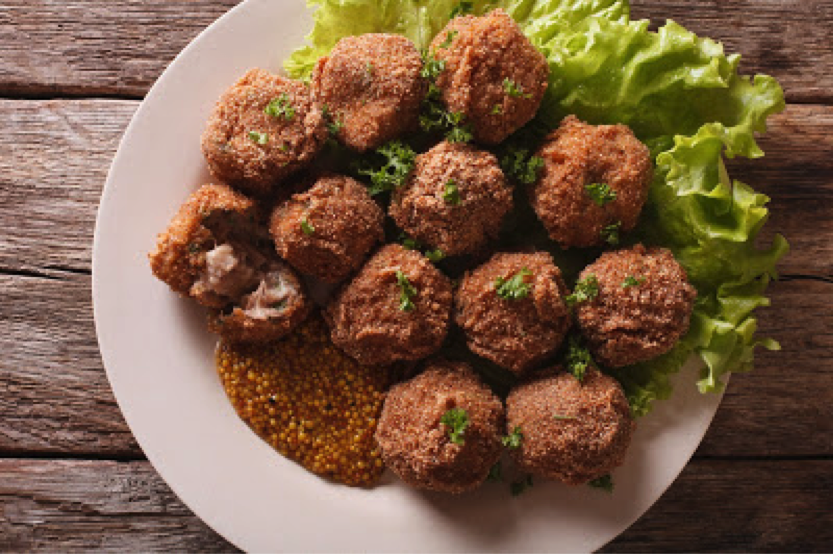
Bitterballen

Bitterballen are deep-fried crispy breaded balls with a tender ragout style savoury filling, typically served with mustard for dipping. Traditionally they are made from beef stock, beef, flour, butter, onion, parsley, nutmeg, salt and pepper. However, they can also be prepared with chicken, veal and even mushrooms. Bitterballen are highly likely to contain FODMAPs, specifically fructans from onion, and are therefore best limited if you’re sensitive to onion/fructans.

Goudse kaas

It is easy to find an excuse to eat cheese any time of day whilst in The Netherlands.  Arguably, the most well known Dutch cheese is Gouda or Goudse kaas (“cheese from Gouda”), a hard yellow cheese made from cow’s milk.  Dutch cheeses are classified by how long they are aged – jong (1 month), belegen (4 months), oud (10 months) and overjarig(1 year or more). Young cheese is milky and creamy but becomes a drier and stronger in flavour with age. Slices of young cheese are commonly eaten in sandwiches, whilst the aged versions are often served cubed with mustard as a snack with drinks. From a FODMAP perspective, hard yellow cheeses are naturally lactose free and plain gouda can and should be enjoyed! The only thing to watch is high FODMAP flavours of Gouda, such as pesto containing garlic.

Hollandse nieuwe haring

A very traditional Dutch dish is Hollandse nieuwe haring. The raw herring fish is typically served with chopped onions, and can be eaten with or without bread. Herring is rich in omega-3 fatty acids, which have a number of health benefits. Limit FODMAPs by removing the onion or requesting no onion “geen ui”.